Wednesday, 10 October 2018

Best of Salamaua

Pictures by Milen Stiliyanov


Valley View Guest House is your home away from home in Wau

 By SAMPSON BONAI

 LOOKING for a quiet weekend getaway  in a country town in Morobe?

Valley View Guest House in Wau is the right place to relax and unwind from the hectic busy week and the hustle and bustle of the city life.


Wau is four hours drive out of Lae and was once the busiest economic hub of Morobe and New Guinea during the gold rush era in the 1920s and 30s.

Relics from the bygone mining era still stand today.

They are scattered along the highway between Wau and Bulolo

 Two dredges No. 5 and 7 are now rusting away in peace along the highway between Bulolo and Wau and close to Pinetop Bridge area.

The other one No.6 is in Wau.

 Other relics such as old mining trucks were left behind.

The crane that was used to remove heavy machinery and equipment from Junkers aircraft that were flown into Wau and Bulolo in parts and assembled on site to work at the goldfields are is standing to this day.

The four major mining companies that were heavily involved in large scale mining activities were Sunshine Creek Mining, Bulolo Gold Dredging, New Guinea Goldfields and Koranga Gold Sluicing.

Their mining operations were scaled down in the late 1960s and then closed down permanently in 1975 when our country attained Independence from Australia.

 Valley View Guest House was the property of Koranga Gold Sluicing and was the official residence of one of the senior mine managers.

 The three-bedroom property was bought by longtime Wau resident Donna Harvey Hall and converted it into a guest house.


Many people who travelled to Wau and stayed there have described it as "the best".

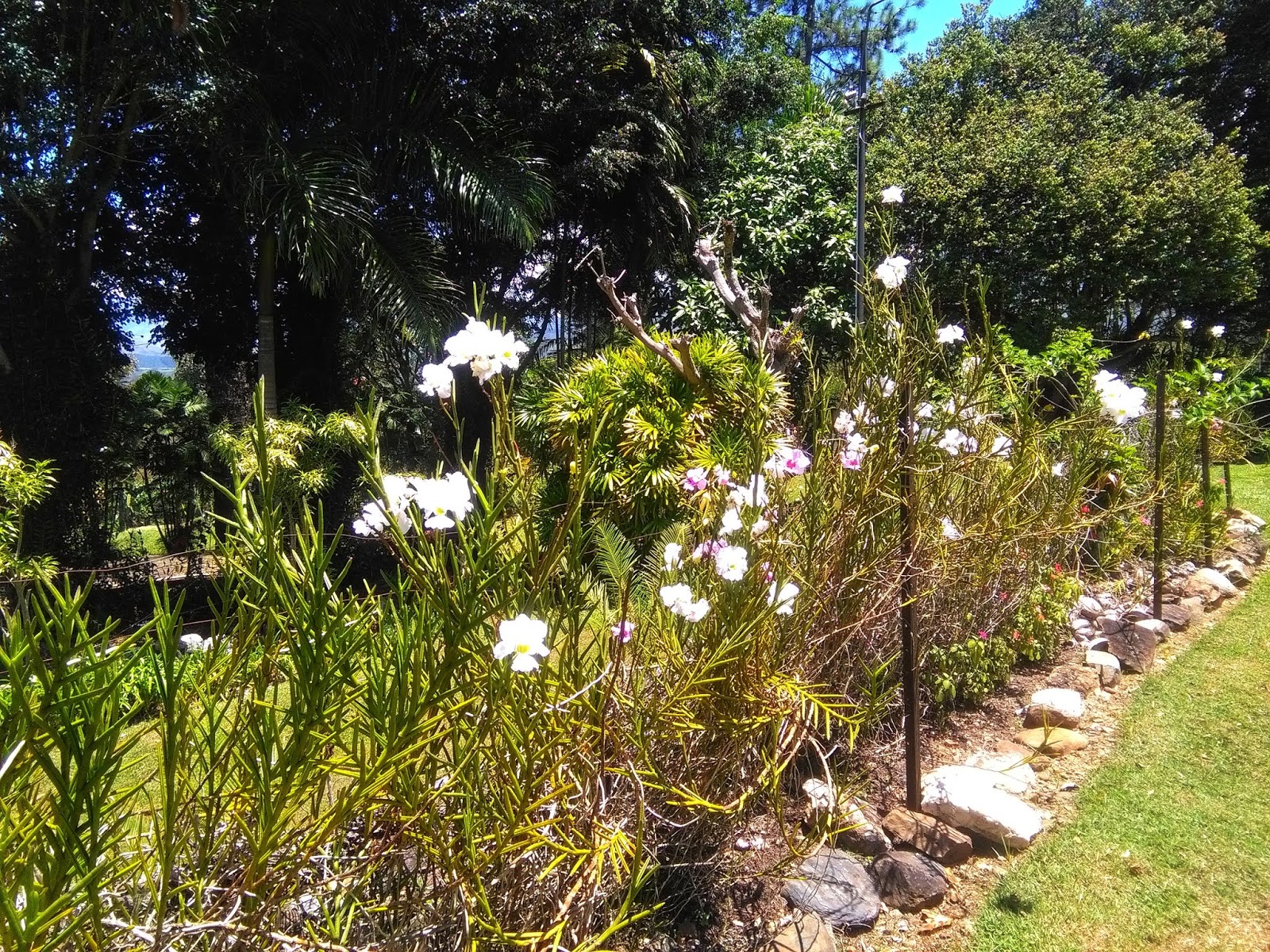
The guest house is situated on a hill top  over looking the Biangai valley and is well kept with beautiful flowers grown within its landscape area.


 The cool climate and the beautiful surrounding has made the guest house a  home away from home for guests.

Guests have described the guest house as "one of the best in Morobe" .


Morobe Governor Ginson Saonu, former Governor Luther Wenge and Bulolo MP and Communications and Energy Minister Sam Basil have all spent time at the guest house.

The guest house is managed by Mrs Keren James Tera.

Tuesday, 9 October 2018

Best of Butaweng Falls, Finschhafen

Butaweng Falls in Finschhafen is one of the most-magical and beautiful places in Papua New Guinea - and the world, for that matter.

Here are some of the most-popular images from our Facebook page:

Darrel Apkas, a final-year University of PNG medical student from Southern Highlands doing his practical in Finschhafen, is smitten by the magic of Butaweng Waterfall. Aug 2018.


Children enjoying themselves at Wara Butaweng in Finschhafen. Aug 11 2018.~Daniel Madom

Butaweng Waterfall, Finschhafen.July 2016.~Shaz Ambang

Butaweng Waterfall remains our biggest attraction, judging by the number of pictures we're receiving. We got this from Melissa Hore, who took this during a 2015 visit to Beautiful Finschhafen for her granddad's funeral.

Butaweng waterfalls, Finschhafen.Sept 22 2018.~Ralph Giumala

Butaweng waterfalls, Finschhafen. 2016.~MJ Mosengi

Butaweng Waterfall, Finschhafen. March 2018.~Daniel Madom

Butaweng waterfalls, Finschhafen. Sept 21 2018.. Like every place you've never been.~Daniel Madom

Butaweng Foot Bridge, Finschhafen.Sept 24 2018.~Daniel Madom

Near 'Phantom's Cave' at Butaweng waterfalls, Finschhafen. Enjoying the magic are Miriam and Jemma,  resident trainees at Braun Memorial Rural Hospital. Sept 2018.~Darrel Apkas

LOCAL TOURIST: Darrel Apkas,  a final-year University of PNG medical student from Southern Highlands doing his practical in Finschhafen, enjoying the magic of Butaweng Waterfall. Aug 2018.

Fun in the sun at Butaweng. Aug 19 2018.~Daniel Madom

Butaweng Waterfall, Finschhafen. July 2018.~Mark Gariki

Butaweng Falls, Finschhafen. Oct 13 2018.~Daniel Madom
Wara Butaweng, Finschhafen. Oct 13 2018.~Daniel Madom

Sunday, 7 October 2018

Best of Finschhafen

Pictures by DIANA ZURENUOC-MOU

East of Lae is Finschhafen, one of the most-beautiful places in the country, with a lot of history.

Its proximity to Lae and abundance of white sandy beaches make it a great weekend escape.

Butaweng waterfalls and Langemak Bay are the pick of the mainland swimming spots.

Morobe Governor Ginson Saonu hopes that the beauty and history of Finschhafen can help turn it into a thriving tourist destination.

Take my breath away: Talecgidu, Buki, Finschhafen. Dec 31 2017.

Memories of Sweet Finschhafen: Bidding farewell to loved ones at Buki Wharf, Finschhafen, on board Lutheran Shipping's mv Gejamsao. Jan 2012. 


Buki Wharf the way it used to be: The once-bustling Buki Wharf, Finschhafen. Jan 2012.

Sweet Finschhafen: From Buki Beach looking out to Gingala village and point on the left and the northern tip of Matuala Island on the right. Dec 31 2017.

God's Hand: Rising moon over Matuala Island, shines over Buki Bay, Finschhafen. Dec 31 2017.

Islands in the sun: Buki Wharf, Finschhafen, on the right and the southern tip of Matuala and Kumbam islands in the background. Dec 31 2017.

I am sailing: This is how the Kandes sail out of Sweet Finschhafen to Lae. Matuala Island in the background middle, Simbuac Island on the left and Kumbam Island on the right. Jan 5 2018.

Paradise Live: Kilung hamlet (the Namoa family home) between Buki Wharf and Dregerhafen High School, Finschhafen.Jan 2012.

Malacsega village, Finschhafen. Jan 2015.

Dreger Point, Finschhafen. Jan 2014.

Saturday, 6 October 2018

The revival of Garaina

By SAMPSON BONAI

We arrived at remote Garaina on Independence Day 2018.

The closed down Garaina Tea Plantation now standing idle in thick kunai grass with no sign of life.~Pictures by SAMPSON BONAI


People  greeted us when we disembarked from chartered North Coast Aviation Britten Norman Islander aircraft and walked over to the airstrip hangar at Garaina station.

They welcomed us as we carried our bags to the small hangar.

The 20-minute flight from Wau on a fine day gave us an opportunity to glance down from the aircraft to see the mountains separating Waria Valley from Wau.

The towering Owen Stanley Range at Garaina

We flew over the Biangai mountains.

 We could see Lake Trist glittering under the mornng  sun.

Lake Trist as seen from our Britten Norman Islander.


We later flew over the Biaru and Waria mountains before we saw Waria Valley in front of us.

A local man and Grace Memorial Secondary School  principal,  Zukua Koito, who was sitting next to me excitedly pointed out of the window.

We flew over Onora airstrip near the two villages of Sikemu and Kapiso.

Garaina station was in front  of us.

The expatriate pilot steadied the plane as it slowly towards Garaina airstrip and landed safely on the grassy strip.

Locals came rushing to the airstrip and welcomed us in their local Gusamanie language that is widely spoken by the people from Waria Valley.

We grabbed our bags and returned their warm welcome by responding "dzobe".

Wau-based policemen and two local guides arrived and led us along the track towards the LLG headquarters and the soccer fields.

Forty-eight soccer teams participated in the weeklong Waria Valley  Unity Cup Soccer Tournament.

Arihe (men) and Au (women) took out the top accolades and K1000 prizemoney.

Major sponsor and PNG Cocoa Board chief executive officer Boto Gaupu congratulated the winning teams.

PNG Cocoa Board CEO Boto Gaupu (right) with Arihe men's soccer team which took out the 2018 Unity Cup Soccer Tournament


He said next year's event would be even  bigger and better.

"We will launch the Waria Valley cocoa project next year," he said.

"Agriculture Minister Benny Allan and other senior Goverment officers from Waigani will be in Garaina to witness the launching programme."

At Garaina, one other track leads to the primary school, shops, health centre and the closed Department of Agriculture and Livestock office.

Garaina Health Centre which provides  services to the people of Waria Valley

Two shops with Bank South Pacific Eftpos machines, owned by locals and located near the health centre,  continue to provide public servants and local people with basic store goods.

One of the two shops in Garaina that serves public servants and the local people


The goods are flown in by air.

 It's very costly to buy a packet of sugar or rice.

The track then connects further down the road and leads to the local government council area.

The old road that connected Garasa and Bapi villages is now closed and had been turned into bush tracks.

The power line and the generator that used to supply electrocity to the station had also broken down and stands idle.

The people still mention the name of former council manager, John Orebut, who served in Waria in the 1990s.

They described him as the "best council manager of Waria LLG".

The towering Owen Stanley Range right in front us at Garaina runs from Waria all the way to Northern and Milne Bay provinces.

The lawn around the Waria LLG headquarters,  council manager's house, two patrol officers' houses, police barracks area and deteriorating RSL Club house are kept clean at all times.

Waria LLG Manager Pagau Arubidza with his son standing in front of his house at Garaina Station

Waria LLG headquarters lawn is kept clean and the office block is always manned


The cool climate and fertile soil makes Waria Valley one of the best areas to grow cash crops such as coffee, cocoa and tea.

The Garaina tea plantation now covered in tall bushes


The area is an tourist destination.

More guest houses need to be set up at Garaina and surrounding villages.

The local people are very friendly and always look after visitors and government officers passing through their villages with accommodation and food.

Waria Valley will soon transform into one of the biggest cocoa-producing area in Bulolo and Morobe.

A cocoa nursery in Bulolo


More local people will venture into various business activities to sustain their lives when cocoa production begins.

Tourism will be one area the local people can venture into.

They can build guest houses in the villages for tourists visiting their area for trekking, birdwatching and various other activities.

Finally the day arrived for us to return back to Wau.

I packed my bag, said goodbye to my new friends and walked to the airstrip to the rest of our team travelling back to Wau.

"Aipo",  all my new-found Garaina friends.

 See all of you again next year for a bigger and better soccer tournament to coincide with  launching of Waria Valley Cocoa Project.

Tuesday, 2 October 2018

Dive seasons in Papua New Guinea

by Rebecca Strauss, scubadiverlife.com
September 30, 2018 

Occupying the eastern half of New Guinea, the world’s second largest island after Greenland, Papua New Guinea sits high atop almost every diver’s bucket list.

But in a land that spans 178,000 square miles (461,000 square kilometers), you’ve got to know where to go — and when — to get the most bang for your diving buck.

With no highways spanning the entirety of the country’s rugged terrain, dive resorts in PNG give new meaning to the word “remote,” reachable only by small plane in many cases.

Once you’re there, you’re there — and if it’s the right time of year, you’ll be happily stranded among some of the world’s best dive sites.

Here’s our guide to the dive seasons in Papua New Guinea, focusing on the main areas.

Tawali


A wide peninsula juts out of Papua New Guinea’s southeastern corner, pointing like a finger to Milne Bay, home of Tawali Dive Resort.

To get there, one must fly from the capital city of Port Moresby to Alotau.

From there it’s a 90-minute bus ride through the countryside to small dock, where a boat awaits to make the final 20-minute journey to the resort.

 Milne Bay is most well-known for muck diving, but there are manta-cleaning stations and WWII wrecks on hand as well.

Sitting on the north coast at the tip of the peninsula, Tawali is mostly sheltered from prevailing southeast winds.

 So even if the winds are blowing, visitors can still dive the protected northern sites.

If the air is calm, divers have access to a plethora of sites south and southeast of the resort.

Nonetheless, the very best time to visit this area of PNG is from October through March, when visibility is the best and the skies are relatively calm.

Strong winds in February make getting to most dive sites a challenge.

Tufi


In Oro Province, which makes up most of the peninsula’s northern shore, Tufi Resort perches atop a spectacular green fjord with sweeping views of the water below.

Just as with other PNG resorts, Tufi is quite remote.

 You’ll arrive via small plane from Port Moresby, which lands on a nearby runway, paved by Tufi’s owners to make the resort more accessible.

It’s a short walk or quick car ride to the resort from there.

Although there is diving in the fjords, Tufi’s real draw is the spectacular offshore reefs, five to 10 nautical miles offshore, so remote that many remain unexplored.

 On good-weather days it takes from 15 minutes to over an hour to reach some sites, and steady onshore winds for part of the year make them nearly inaccessible.

The very best time of the year to visit is during wet season, from November to March.

Walindi


Walindi Plantation Resort sits on the shores of Kimbe Bay on New Britain, a PNG satellite island just north of the mainland.

To get here, you’ll fly from Port Moresby to Hoskins Airport, also called Kimbe Airport.

From there it’s a 50-minute drive to the resort.

Kimbe Bay is best known for spectacularly healthy coral gardens and walls, and guests can reach even further-flung destinations onboard the resort’s liveaboard dive boats, the MV FeBrina and MV Oceania, which offer 8- through 10-night itineraries.

The best time of year to visit Walindi is April through June and August through December.

Rabaul


Rabaul, also on New Britain at its northern tip, is best known for fantastic WWII wreck diving.

 Most sites are relatively near shore, with the furthest being about an hour’s boat ride away.

Aside from the wrecks, there’s also a healthy shallow-water reef and wall dives, offering the chance to see passing pelagics.

The best time of the year to visit Rabaul is April through early January when the visibility is best and wind direction cooperates with dive boats.

Lissenung


Tiny Lissenung Island is home to a private resort right off the west coast of New Ireland Island, itself just north of New Britain Island.

Visitors fly from Port Moresby to Kavieng, then it’s a 5-minute ride to the shore and a 20-minute boat ride to the resort, which sits just two degrees south of the equator, making for pretty consistent weather year-round.

The island is only 1300 by 262 feet (400 by 80 m) and the resort sleeps a maximum of 16 guests, so you’re guaranteed seclusion.

There are 36 mapped sites nearby, most well-known for pristine coral, sharks, turtles and macro life.

Lissenung is best from late March through early January. Mid-January to mid-March is wet season and although you can still visit, it can get very windy and wet.

Monday, 1 October 2018

Paradise found in Papua New Guinea

Bestowed with stunning natural creations and rich cultural traditions, Papua New Guinea entices visitors like no other
 

Anjaly Thomas
Sep 29 2018
Deccan Herald

Two reasons can take you to Papua New Guinea (PNG) in the Oceania — diving or Kokoda Track. My reason was the latter — a 96-km-long killer track with a reputation of being attempted only by the ‘brave’. Fully aware of the dangers, I plunged into the tropical rainforests of Papua New Guinea, and for 11 days, pushed myself beyond every imaginable limit, and emerged on the other side intact, but determined never to attempt anything like that again.

An aerial view of the islands in Papua New Guinea

So once back in the capital Port Moresby, fondly called Pom Town, I set about understanding why Papua New Guinea was the new tourist hotspot. PNG has over 7,000 different tribes, each with their own language, and Port Moresby is the entry point to the country, ideally located on the coast and perfect for exploration of the rest of the country.
A word of caution. Papua New Guinea is still considered a dangerous place to visit, but the good news is that the tourism industry is slowly growing. Beautiful nature hikes, scuba diving and kayaking are the top attractions in this island nation. Although tourism infrastructure is lacking, you cannot ignore the fact that the country offers incredible sights and activities for those wishing to explore.

My first destination was Bomana War Cemetery (BWC), the resting place of about 3,200 servicemen from World War II, killed in action in Papua and Bougainville. BWC, about 20 km from Port Moresby, is a well-maintained and the only cemetery in the country to contain white marble headstones. Memorial services for Anzac Day are held here on April 25 every year. I knew very little about the importance of Anzac Day, till I walked on the Kokoda Track, which still bears the scars of the fighting between the Japanese and the Allies.

Next on the cards was a visit to Port Moresby Nature Park, a botanical garden and zoological park that is home to hundreds of animals, including kangaroos and reptiles, and it’s the only rainforest track in the city. Particularly fascinating was walking through rows of native plants and orchids. To truly understand the orchid variety, a visit here is a must. There are over 10,000 orchids in the park!

Towards evening, I headed to a local market in Pom Town. It was like walking back in history — there was nothing ‘modern’ about the market — just picturesque stalls selling food, local crafts, paintings, traditional carvings. I returned with wooden masks and meri blouse (traditional dress): loose-fitting, and comfortable but a fashion disaster, and stuffed to my gills on taro and cassava, which my hotel receptionist told me was “the thing to do anyway.” It was she who put the idea of visiting the Parliament House into my head. “You can see the birds later,” she said. With a phone call, she arranged a tour of the Parliament House and the next morning, I found myself with a guide and permission to enter the building.

It is said a passionate guide can make or break your impressions — my guide influenced my opinions favourably. The gardens and orchids are fabulous and so are the flags that represent many different tribes in the country. Fortunately, the Parliament was not in session, so we could easily look into the floor of the Parliament. The grandeur of the building was hard to ignore, but pictures are forbidden, not even discreetly!

The city of Port Moresby is charming in a rather quaint way. Nightlife is decent and a few good restaurants have cropped up in the recent past, a sign that PNG is gearing up to welcoming more tourists in the near future.

It is amazing how much of the country is still unexplored and you often get the feeling that it is a civilisation yet to be discovered. From tropical birds to vibrant colours, cultures and tribal traditions — everything conspires to make you fall in love with the place.